Instructional Model

Explorations are open-ended data investigations designed to get your students exploring and asking questions of data in the same way that professional scientists do! What does this look like? Much like our structured lessons, each Exploration comes with a teacher guide, slide deck, and student worksheet; however, with Explorations, students build their own data visualizations as they seek to answer their own questions. 

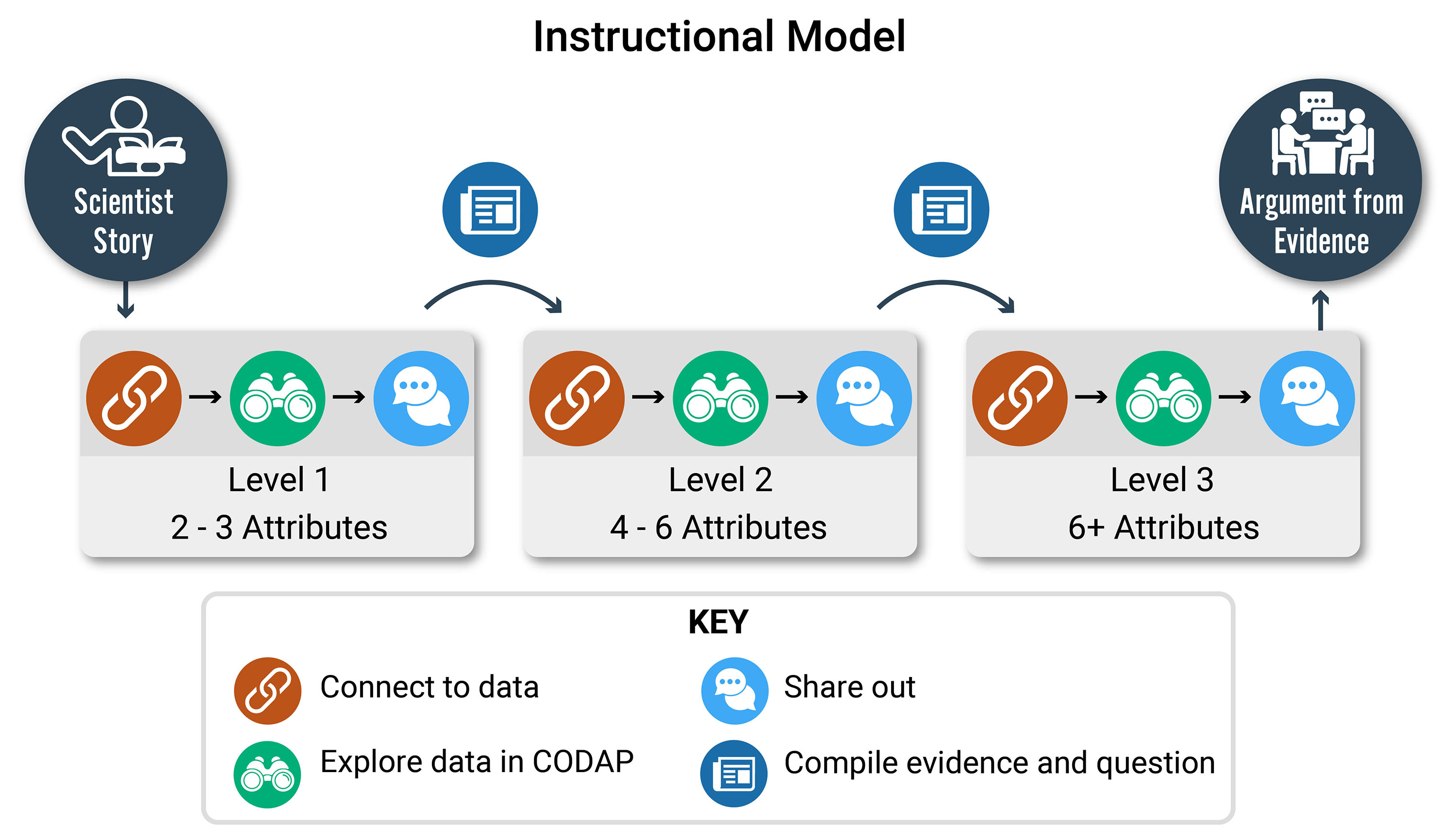
After learning about a featured scientist's story via the teacher slide deck, students connect to and explore a subset (2-3 attributes/variable) of this same scientist's dataset in an NSF-funded tool called CODAP. Students are asked to document 1-2 of the data visualizations they build in CODAP on their student worksheets and then share their noticings/wonderings with the class. Evidence and new questions generated during this whole class share out should be added to a public record that then leads to another round of data exploration with additional variables (4-6 attributes) in CODAP as part of level 2. This process continues, ultimately culminating in students constructing their own argument from evidence using the claim-evidence-reasoning structure.

 

Image

Scientist Story

The purpose of the "Scientist Story" routine is to elicit student resources (e.g., past experiences, prior knowledge, language) as they relate to the phenomenon presented in the Exploration.

  •  Teacher Tip: Use the prompts, images, and videos included in Exploration slide decks to generate small group and whole class discussions.
Image

Connect to Data

The purpose of the "Connect to Data" routine is to introduce students to the attributes (variables) they'll explore in each level and to challenge them to think about how these attributes might connect to one another and help the scientists learn more about the phenomenon.

  • Teacher Tip: Don't rush these discussions! Student ideas and predictions constructed here will help guide their decision-making when they develop their own data visualizations in the next routine.
Image

Explore Data in CODAP

The purpose of the Explore Data in CODAP routine is to give students time to investigate their own ideas, predications, and questions by constructing data visualizations in CODAP. 

  • Teacher Tip: At each level, students should first get 10 minutes to explore the attributes by constructing data visualizations; then, 10 additional minutes to add 1-2 of their data visualizations (via screen shot) to their student worksheet and document their noticings and wonderings as they relate to their data visualizations.
Image

Share Out

The purpose of the Share Out routine is give students space to share their data visualizations with the whole class (including noticings/wondering) to collectively build new understandings together.

  • Teacher Tip: The teacher should project their screen and build the data visualizations described by students for all to see. This will 1) allow for all students to engage with the data visualization described by their peers, and 2) give YOU an opportunity to highlight different features in CODAP that students may not be aware of, thereby building their technology skills.
Image

Compile Evidence and Questions

The purpose of the Compile Evidence and Questions routine is to publicly keep track of the patterns and new understandings collectively shared during the previous Share Out routine through the development of a *Learning Tracker. Student questions documented in this routine are intended to launch students into the next level and inspire further investigation. Students should be encouraged to investigate their own questions!!!

Teacher Tip: 

  • *Use a large piece of butcher paper and sticky notes to construct the Learning Tracker (whole class T-chart). We recommend using the same color sticky notes for each level. For example, yellow sticky notes for level 1, green sticky notes for level 2, and blue sticky notes for level 3 so that students can see how their evidence and questions grew and developed during the Exploration.
  • These patterns/new understandings will build with each level and act as a resource students will refer to when they construct their final arguments. 
Image

Argument from Evidence

The purpose of the Argument from Evidence routine is to provide students with a structured opportunity to use generate their own argument in defense of their interpretation of the data (levels 1-3).

  • Teacher Tip: Before engaging students with the C-E-R graphic organizer, collaboratively organize the sticky notes (evidence) on the Learner Tracker by like-categories. This will help students develop focused claims and lead to stronger reasoning statements (connecting the claims to the evidence).